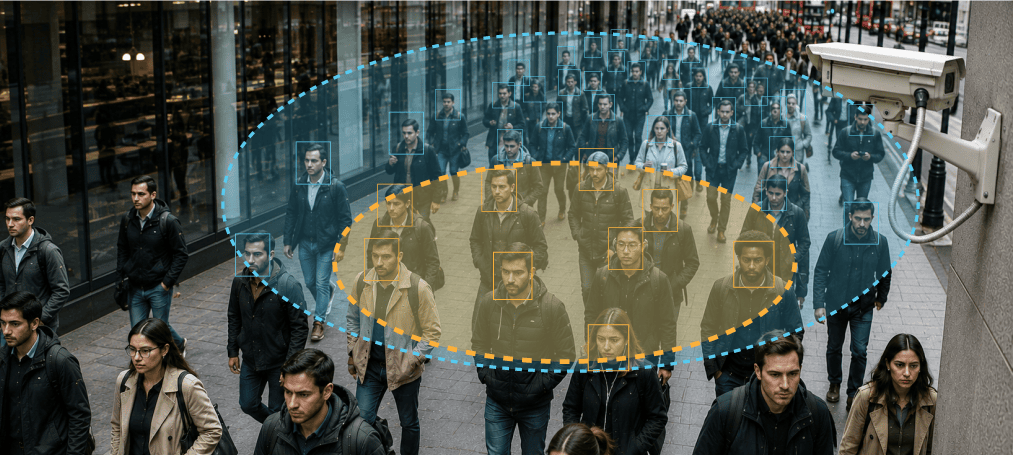

This week I read an article in GB News discussing the growing use of Live Facial Recognition (LFR) by UK police forces.
The latest figures on live facial recognition in England and Wales are compelling. During 369 police operations last year, approximately 9.25 million faces were scanned and 1,317 people were taken into custody. Those arrests included suspects linked to violent offences, sexual harm orders, aggravated burglary and serious incidents at major public events.
These outcomes demonstrate a point that should no longer be controversial: when deployed responsibly, live facial recognition can help police identify wanted individuals who might otherwise remain at large. But the figures also raise a more important question:
How many wanted people walked straight past the cameras without ever being identified?
That number is rarely reported, yet it is one of the most important measures of operational performance.
Consider a hypothetical example. A system identifies 1,000 wanted individuals and helps police take them into custody. On its own, that number sounds highly impressive. But what if 5,000 wanted individuals actually passed through the areas covered by those cameras? The same result would then represent a detection rate of only 20%. Suddenly, the headline number looks very different. The system helped arrest 1,000 people, but it also failed to identify 4,000 others who should have been detected.
This is not a claim about the figures reported in the article. It illustrates why arrest numbers alone cannot tell us how well a facial recognition system is performing. Real policing environments are not controlled laboratories. People do not approach cameras in perfect lighting, at an ideal distance or directly through the centre of the frame. They appear at difficult angles, move through crowded scenes, turn their heads, wear hats or glasses and pass through areas covered by CCTV systems that were never designed specifically for facial recognition.
This means that two technologies deployed in the same location, using the same cameras and the same watchlist, can produce dramatically different results.
One may identify a person only when the face is captured under favourable conditions. Another may continue to perform across a much wider part of the scene and under far more challenging real-world conditions.
This distinction has real operational consequences. It determines whether a wanted person is taken into custody or simply walks away – and how quickly a local police force can translate that capability into real improvements in community safety.
As police forces increase their use of live facial recognition, technology selection must therefore move beyond headline arrest numbers. Forces should ask:
- How much of the camera’s field of view is genuinely usable?
- How well does the system perform when faces are distant, angled, moving or partially obscured?
- Can it operate effectively using existing CCTV infrastructure?
- How many genuine persons of interest are missed during a deployment?
These questions matter even more as the programme expands nationally. Increasing the number of deployments and surveillance vehicles will create more opportunities to locate wanted individuals, but scale alone will not guarantee better results.
A wider deployment of limited technology simply produces limited performance at greater scale.
The next generation of live facial recognition must be built for the conditions police actually face, not the conditions engineers would prefer. It must identify people across the wider scene, under difficult lighting, through imperfect cameras and without requiring individuals to cooperate with the system.
The real value of facial recognition is therefore not measured by how many faces it processes, or even by the absolute number of arrests it supports. It is measured by the proportion of wanted individuals it successfully identifies, and by how few it allows to pass unnoticed.
The reported arrests show what live facial recognition can already achieve.
The next question is how many more wanted individuals could be taken into custody if police forces deployed technology capable of seeing beyond the easiest part of the frame.
